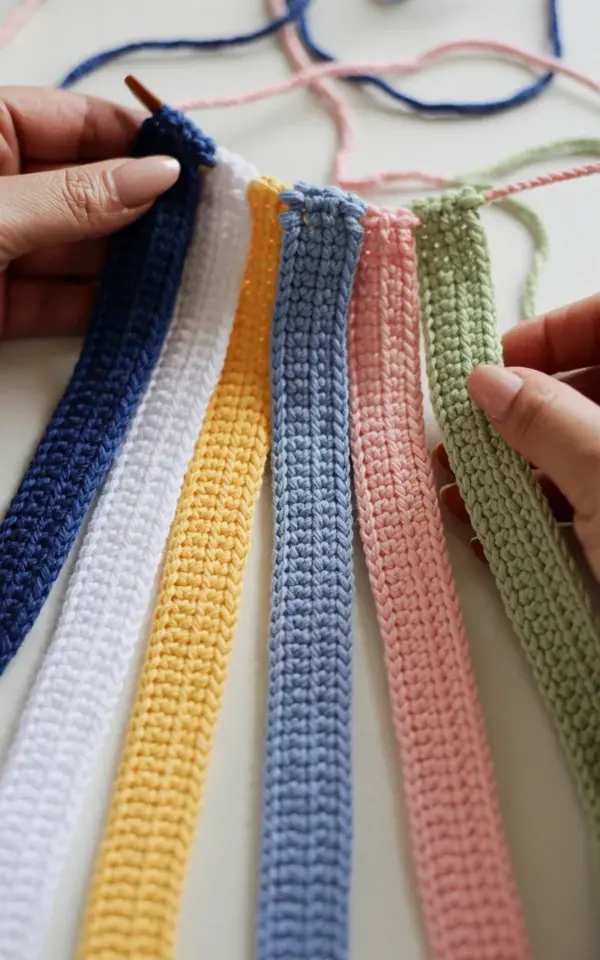
The photo on my cutting mat shows twelve crochet strips fanned out like a hand of cards. Navy, white, yellow, light blue, pink, and sage green, each one worked in single crochet with that soft ribbed texture that only comes from consistent tension. A hand with nude polish holds the top edges together, and a pink thread runs through them, waiting to be sewn. I have made this exact arrangement more times than I can count, and every single time I learn something new about the mistakes that almost ruined it. This article is a honest look at those common crochet strip mistakes, and how to avoid them, so your scrap yarn project turns out as neat as the picture in your head.
Why Your Crochet Strips End Up Wavy Instead of Flat
The most common mistake I see is ignoring the edge chain when you turn at the end of each row. In single crochet, that turning chain is not just a decoration. If you skip it, your strip will pull in on one side and flare on the other. If you make it too loose, you will get a wavy edge that looks nothing like the clean strips in the fan pattern photo.
Check your first and last stitch of every row. Many beginners accidentally work into the turning chain of the previous row, which adds an extra stitch and makes the strip wider as you go. For straight strips, mark the first stitch with a stitch marker and count your stitches after every five rows. A flat strip should have perfectly parallel sides, like the ones laid out on that white surface.
Choosing the Wrong Yarn Weight for Scrap Yarn Strips
Scrap yarn is tempting because it is free, but mixing a bulky weight with a fingering weight in the same strip will give you a lumpy mess. The strips in the photo all have the same thickness, which is why they fan out so evenly. If you want that same crisp look, sort your scraps by weight before you start.
For single crochet strips, a worsted weight yarn is the easiest to work with because it shows off the ribbed texture without being too stiff. If you only have lighter yarn, hold two strands together to make a similar weight. Also think about fiber content. A cotton strip will stretch less than an acrylic one, so mixing them in the same project can cause curling. Test one strip, wash it, and see what it does before you commit.
Color Placement: How to Arrange Crochet Strip Colors in a Fan Pattern
Arranging colors is where most people get shy, but the fan pattern gives you a natural starting point. Think of the pink thread as the center of the fan, and let the colors radiate from there. In the photo, navy anchors one side, then white, yellow, light blue, pink, and sage follow. That order is not random. It moves from dark to light to dark again, which creates a gentle rhythm.
Here are a few color arrangement mistakes I have made and fixed:
- Putting two cool colors next to each other without a neutral to break them up.
- Using all bright colors with no dark anchor, which makes the eye jump around.
- Forgetting to step back and look at the photo on your phone camera in black and white to check contrast.
- Assuming the order you lay the strips in is the final order, when you can easily swap them before sewing.
When you lay your strips out, do not sew them together right away. Leave them fanned out for an hour, or overnight, and look at them under different light. The pink thread holding them together in the photo is not just functional, it is also a color statement. Choose a thread color that either matches one of the strips or provides a tiny surprise.
The Truth About Single Crochet Ribbed Texture
The ribbed texture in the photo comes from working single crochet through the back loop only. That is the trick. If you work through both loops, you get a flat, brick-like texture. Through the back loop, the front loops form a subtle ridge that runs across the strip, and that ridge is what makes the fabric look soft and woven even though it is just single crochet.
A common mistake is to switch between back loop and front loop without realizing it. Decide at the beginning of each strip and write it down. Another issue is tension. Ribbed single crochet is naturally denser than regular single crochet, so you need to use a hook one size larger than you normally would for that yarn. Otherwise, the strips will be stiff as cardboard. The photo shows soft strips that you can bend easily, so aim for a relaxed hand.
Counting Stitches and Rows When Making Multiple Crochet Strips
You will never get a perfect fan pattern if one strip has forty stitches and another has thirty-five. The whole shape depends on strips that are exactly the same length and width. I learned this the hard way when I sewed six strips together and ended up with a lopsided blanket edge.
Instead of counting every row aloud, write down your starting chain count on a sticky note and keep it next to your work. Every strip should start with the exact same number of chains. Also, count rows every ten rows and use a row counter. When you finish all the strips, stack them. If one is longer, you can gently stretch it while it is damp, but do not rely on that. The easiest fix is to unravel that one strip and redo it. Redoing one strip is faster than fighting with six mismatched ones later.
Joining Strips Too Tightly or Too Loosely
The pink thread in the photo is doing a lot of work. It runs through the tops of the strips, connecting them before the final sewing step. If you pull that thread too tight, the strips will gather and ruffle. If you leave it too loose, you will see gaps between the strips. The goal is a firm hold that still lets the fabric lie flat.
Use a thread that is one weight lighter than your strips, or even embroidery floss, as long as it does not break. When you sew strips together, use a whipstitch through the back loops only on both edges. That way the seam stays flat and flexible. And here is a mistake I see all the time: people sew from one end to the other without pinning the strips together first. Pin the seams every few inches, then sew slowly. Your finished piece will look as neatly aligned as the strips in the fan pattern.
Once you understand these common mistakes, crochet strips become one of the most forgiving scrap yarn projects you can make. They are portable, easy to disassemble, and perfect for using up all those odd balls of navy, white, yellow, light blue, pink, and sage. The next time you catch yourself pulling a strip out, do not get frustrated. That is just part of the process.
I would love to know what you plan to make with this color palette. A baby blanket? A cushion cover? A hanging wall piece? Share your idea in the comments, and if you try the back loop single crochet trick, tell us how it goes.
Leave a Comment