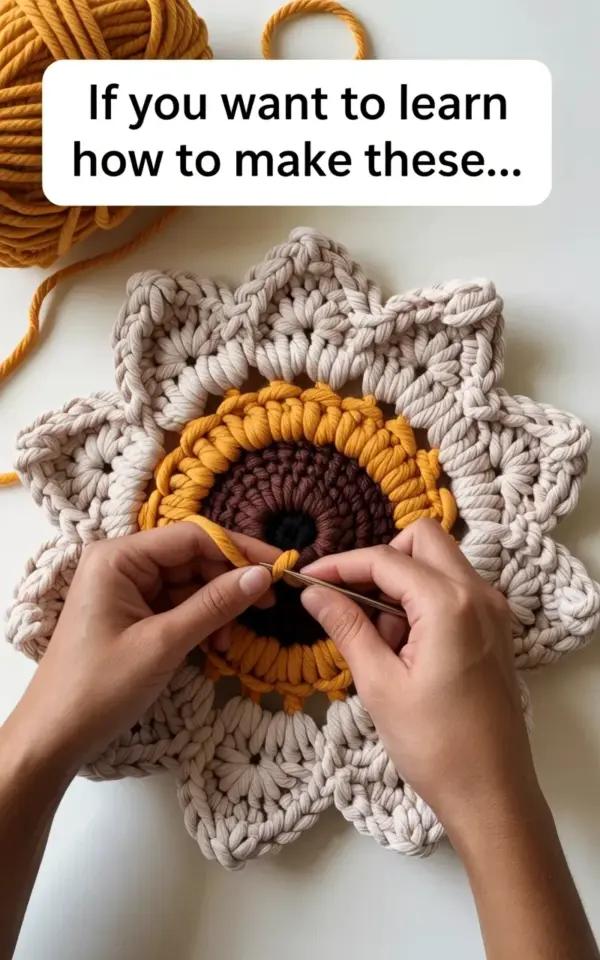
Honestly, I think the chunky yarn sunflower might be the most satisfying fifteen minutes you can have with a hook in your hand. The way those thick mustard yellow strands stack against the dark brown center is pure texture, you can almost see the velvet in the photo. That close-up shot of the hands at work, with the white sign up top teasing the pattern, that is the exact moment I want to help you recreate.
I have made this crochet sunflower pattern so many times that I have the stitch counts memorized, but I have also frogged more than my fair share of disasters. Most tutorials show you the perfect flower, not the tangled, frustrating attempts that happen before it. So let’s skip the headache and talk about the common mistakes that turn a beautiful blanket into a lumpy mess. Specifically, the issues with tension, sizing, and that sneaky curling that happens on the back edge.
Choosing the Perfect Chunky Yarn and Hook Size
The wrong yarn weight is the number one reason your flower looks sad and floppy. This pattern lives and dies by the density of the fabric. If you try to use a worsted weight yarn, your petals will have no structure; they will just flop over like a tired puppy. You want a yarn that holds its shape, look for a Category 6 or Super Bulky weight.
That image we are referencing shows a cream-colored background with what looks like a softer, wool-blend chunky yarn. You want something with a bit of friction, not a slippery acrylic that fights your tension.
Here is the shortlist of what I usually grab from my bin:
– Lion Brand Wool-Ease Thick & Quick (my absolute favorite for stitch definition)
– A basic acrylic chunky yarn (cheap and cheerful, works fine if you tighten your grip)
– Any wool blend you have lying around (the fuzzier, the better for hiding small mistakes)
For the hook, do not be tempted to use the size recommended on the yarn label. Go down by 1.0 mm to 1.5 mm. Your hands need to work harder to pull the loops through, and that extra friction creates a stiff, sturdy flower that won’t collapse. I use a 10.00 mm hook for a worsted weight, but for this chunky crochet flower, I switch to a 9.00 mm.
The Dark Brown Center: Avoiding the Curling Mistake
The center of the sunflower in the main photo is that delicious, deep dark brown. It looks flat and neat, but getting that flatness is where most people fail. The usual culprit is crocheting the center too tightly or, conversely, adding too many increases in the first few rounds.
If your center starts to ruffle like a cabbage, you have added too many stitches. If it looks like a bowl, you have made the magic ring too tight or your tension is too stiff. Ok so here is the trick: use a larger hook for the center rounds only, then drop back down to your smaller hook for the petals.
Do not pull that magic ring so tight that it disappears. You want a tiny hole in the middle, just enough to show the surface underneath. It keeps the crochet sunflower pattern looking organic, and honestly, it makes sewing it onto a blanket much easier.
Detailed Petals: Why Yours Look Like Lumpy Ovals
The petals are the star of the show, and in the photo, those mustard yellow shapes have a clear, embossed ridge running up the middle. This is not an accident of the yarn; it is a structural choice. If you simply chain and double crochet without looking at the back loop, you lose that central vein that makes the flower look realistic.
The most common mistake here is missing the stitch placement. When you work your petals into the preceding round, you need to be precise.
– Always skip the first stitch after joining to avoid shifting the pattern.
– Work your double crochets into the front loop only to create that crisp ridge.
– Keep the chain count identical for every petal, no exceptions.
When you do this, the petal turns from a shapeless blob into a hand-drawn leaf that fans out naturally. And speaking of the edges, do not be lazy with your picot stitch at the tip if the tutorial calls for it. That little bump is what stops the chunky wool from looking like a solid trapezoid.
Tension Troubles with Chunky Yarn
Chunky yarn hides mistakes well, but it punishes inconsistent tension harshly. Your hand cramps up, you hurry, and suddenly your first petal is twice the size of the last one. A crochet sunflower pattern using bulky thickness yarns requires a steady, rhythmic pull.
Here is a mildly annoying personal tangent: I have to put my yarn bowl on the floor to force myself to keep my tension loose. If I hold the skein in my lap, I instinctively grip the working yarn too tightly and end up with a curly mess. Try it. Let the weight of the yarn feed itself.
If your hands are cramping, you are pulling the yarn too tightly. Relax your shoulders and let the hook do the work. The size of the hands in the reference picture look relaxed, they are holding the project gently. That is the goal.
Joining Rounds and Hiding the Seam
If you are working in continuous rounds, your seam will spiral and show up like a scar on the dark brown center. Since our centers are so textured, it is actually better to use a slip stitch join at the end of each round. I used to hate seam lines, but with this chunky yarn, the seam camouflages perfectly into the fluff.
The mistake is pulling your joining slip stitch too tight. You leave a little dent at the end of the round that is impossible to fix. Pull the loop up to the same height as the other stitches around it, not tighter. Then, when you add the mustard yellow petal layer, ensure the starting tail is woven into the center, not the front, so it does not peek through.
Blocking and Finishing for the Perfect Wall Hanging
Look, you have spent the effort, and blocking is not a glamorous step, but it makes a difference. Many people skip it because they are afraid of ruining the stiffness. The best way to finish a chunky sunflower is with a simple steam block.
Pin the flower face down to an ironing board and stretch the petals outward gently. Hold a steamer above the petals, do not press down, or you will flatten the gorgeous fuzz. Let it cool completely before you remove the pins. This fixes the lumpiness and makes the petals lie perfectly flat like in the photo reference.
If you are sewing this onto a blanket, keep the stitches loose on the back. If you pull too hard, the blanket will pucker. Just tack it down at the center and the tips of the petals, and you are good to go.
A Quick Checklist for Your Next Chunky Sunflower
– Grab the heaviest yarn you own.
– Downsize the hook by 1.0 mm.
– Loosen your grip (put the yarn on the floor).
– Work the petals in the front loops.
– Steam block at the end to even out the edges.
That is the whole secret. It is a forgiving pattern once you know what to look for, and watching that dark brown center turn into a bright flower is genuinely addictive. I have three of these sitting on my coffee table right now, and I still want to make another.
I hope your brave attempt at this crochet sunflower pattern turns out beautifully. If it does, let me know, and tag me when you post it. Happy hooking. 🌻
Leave a Comment